
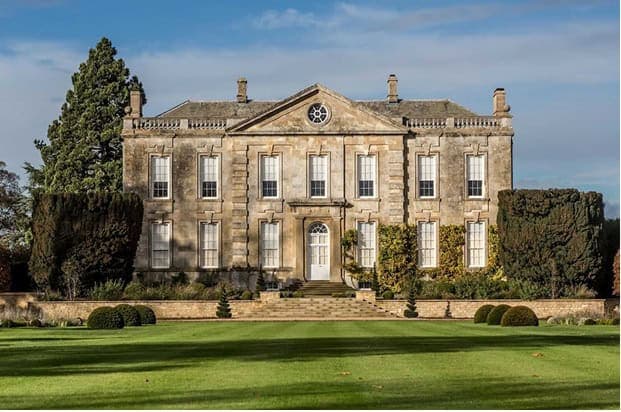
Bruern Abbey Building Renovation and Works 1980 - 1989
Bruern Abbey, located near Churchill in Oxfordshire, rests on the site of a Cistercian Monastery which was established in 1147 by Nicholas Bassett and which existed until the Dissolution of Monasteries in 1536. Around 1720 a house was built on the site for Sir Jonathan Cope, which then suffered a devastating fire in the late 1700s, leaving only the magnificent seven-bay South Front, to which East and West Perpendicular Wings were subsequent added in the 19th century. In 1947 the house was acquired by Michael Astor, youngest son of Nancy Astor, the American born first female member of Parliament. In the 1970s Michale Astor removed two of the three floors from the Perpendicular Wings, substantially reducing the house in size. When Michael Astor died in 1980 his wife and widow Judy Astor moved to a smaller dowager house on the estate before putting the main house on the market, which I then acquired.
Michael Astor’s alterations in the 1970s were not universally welcomed by all the family and indeed produced a mismatch between a grand four-square building and three single story dormered wings. There was no prominent entrance or entry hall, but simply a small cottage-like door on the west side, while the dining room was confined to a small, vaulted room on the ground floor next to the kitchen. Worst of all, the internal courtyard formed by the three wings was totally paved over and used largely for domestic purposes, including the storage of dust bins.
Given these deficiencies, which I thought were not worthy of the main building, I engaged Anthony Paine, an award-winning international designer of classical buildings, to help put things right. I engaged him in around 1980 to help with the renovation.
The first was the entrance. Given that the north side of the house is on a public road, it is necessary to initially enter the property from the west, no doubt the reason for the insignificant cottage type door. Given this limitation I decided to create a series of cloisters on the west and south side of the internal courtyard, which I then planted with a series of grass parterres, evoking the monastic origins of the property. More importantly this enabled me to create a new ground floor entrance and entry hall on the imposing north front, with pedestrian access through the cloisters from the west parking area.
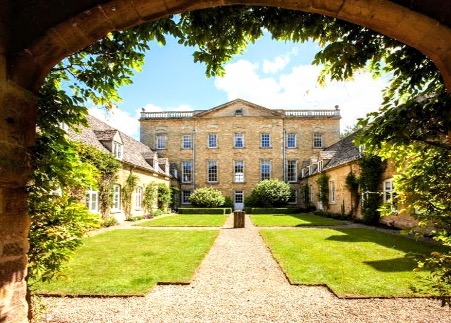
Creating a new large and imposing entrance hall involved the demolition of several rooms on the ground floor which had previously been used as domestic offices. More complicatedly, as I wanted a large fireplace to be the entrance hall’s central feature, it meant running a new chimney the entire height of the house, which had to be cantilevered given my plans for the first floor. It was a massive job and involved the opening up of walls on the ground, first and second floors.
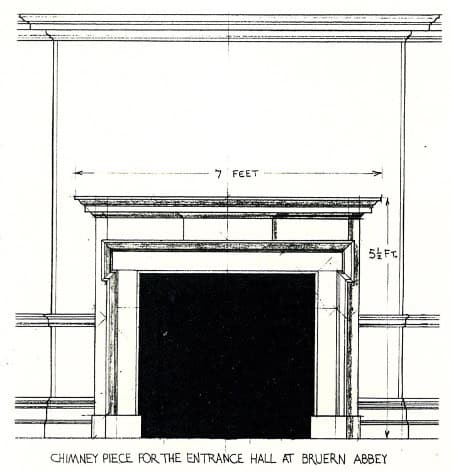
Still at the end of the day the house now had a large entry hall running virtually the entire width of building and focused on a large central fireplace.
As previously indicated, the house had been much reduced in size and depth in the 1970s, with the first floor consisting of three original rooms facing south, and a Long Gallery running the length of the North Front. The largest room was the Drawing Room, which opened on to the South Terrace, with two smaller rooms either side, then used as a Music Room and a Study. Notwithstanding the central position and prominence of the Drawing Room, the entrance to it from the Long Gallery was a small door in the corner, something which made no sense at all. I therefore decided to make a larger and more prominent central entrance (hence the need to cantilever the ground floor chimney flue) with double doors under a classical pediment. Not surprisingly during construction there was evidence of a previous central door opening, no doubt lost during the 19th century modifications.
While I left the east facing Study untouched, I also opened up the blinded west facing windows in the Music Room to give a view down a magnificent alley of plane trees, and relocated the Dining Room to this space, notwithstanding its length from the ground floor kitchen!
While the Long Gallery was impressive in its own right, Anthony Paine suggested and designed a console table and a large mirror for one end, thereby doubling the impression of its length. The space was then painted a shade toccata red with a pale cloudlike ceiling, giving an overall renaissance feel to the space. It was, and remains, the most impressive space in the entire house.
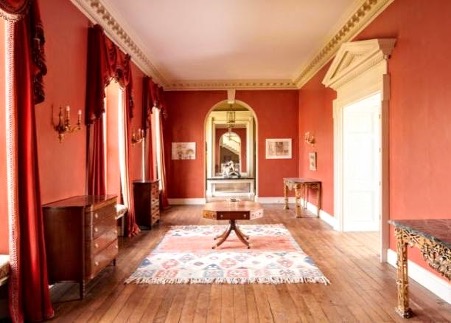
Notwithstanding these alterations, the building soon proved too small for the school that was established in its three courtyard wings and so was reluctantly put on the market in 1990. I left it with regret, knowing that I was unlikely to ever again live in such a magnificent house.
Here's how Bruern Abbey looks now.
More Images of Bruern Abbey's Renovation Works
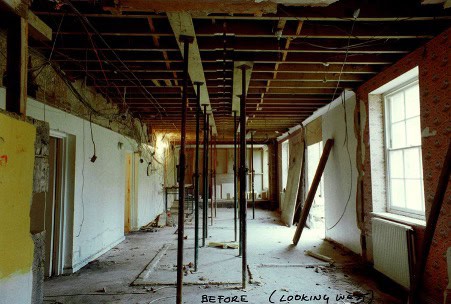
Here's how the entrance hall looked before work started to renovate the property.
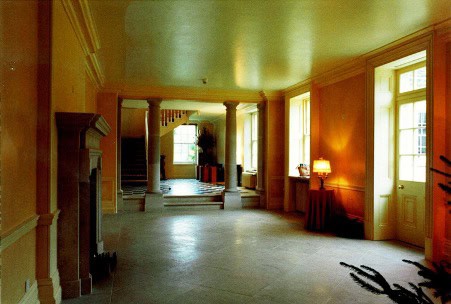
After the extensive work, the hall looked almost entirely different compared to how it had been.